
Profile

|
M. Sc. Julia Berger |
Publications
Biased Dreams: Limitations to Epistemic Uncertainty Quantification in Latent Dynamics Models

Model-based reinforcement learning distinguishes between dynamics models operating on proprioceptive states and latent dynamics models typically operating on high-dimensional image observations. Among the latter, Dreamer's Recurrent State Space Model (RSSM) has emerged as a dominant architecture. While ensemble-based epistemic uncertainty has proven effective in proprioceptive dynamics for mitigating model exploitation, guiding exploration, or promoting caution, its behavior in latent dynamics remains largely unexplored. Our experiments reveal that although ensemble disagreement captures local epistemic uncertainty, it does not reliably reflect global compounding model error accumulated over prolonged RSSM latent rollouts. We provide evidence for an attractor behavior that draws rollouts toward well-supported latent regions, where uncertainty diminishes despite increasing discrepancies from the true environment dynamics. This can cause the model to overestimate returns when attractor regions correspond to high-reward behaviors. Our findings reveal a structural limitation of epistemic uncertainty estimation in RSSMs and challenge the assumption that epistemic uncertainty estimation transfers directly from proprioceptive to latent dynamics.
Retargeting Visual Data with Deformation Fields
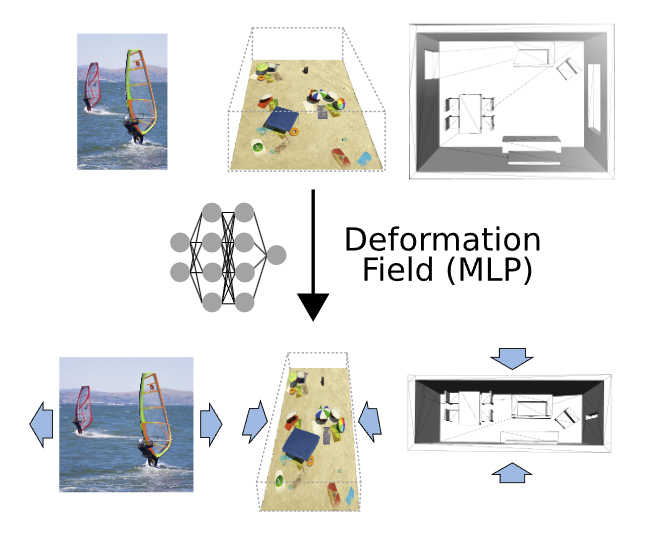
Seam carving is an image editing method that enables content- aware resizing, including operations like removing objects. However, the seam-finding strategy based on dynamic programming or graph-cut lim- its its applications to broader visual data formats and degrees of freedom for editing. Our observation is that describing the editing and retargeting of images more generally by a deformation field yields a generalisation of content-aware deformations. We propose to learn a deformation with a neural network that keeps the output plausible while trying to deform it only in places with low information content. This technique applies to different kinds of visual data, including images, 3D scenes given as neu- ral radiance fields, or even polygon meshes. Experiments conducted on different visual data show that our method achieves better content-aware retargeting compared to previous methods.
